
Aerostructures · 1 Dec 2025 · KFUPM ASCENT
Meet ASCENT-1, the 3D-printed rocket we learned on
ASCENT-1's design began in late 2025. We wrote up its story on 1 November 2026, so it also covers its flights and what came next.
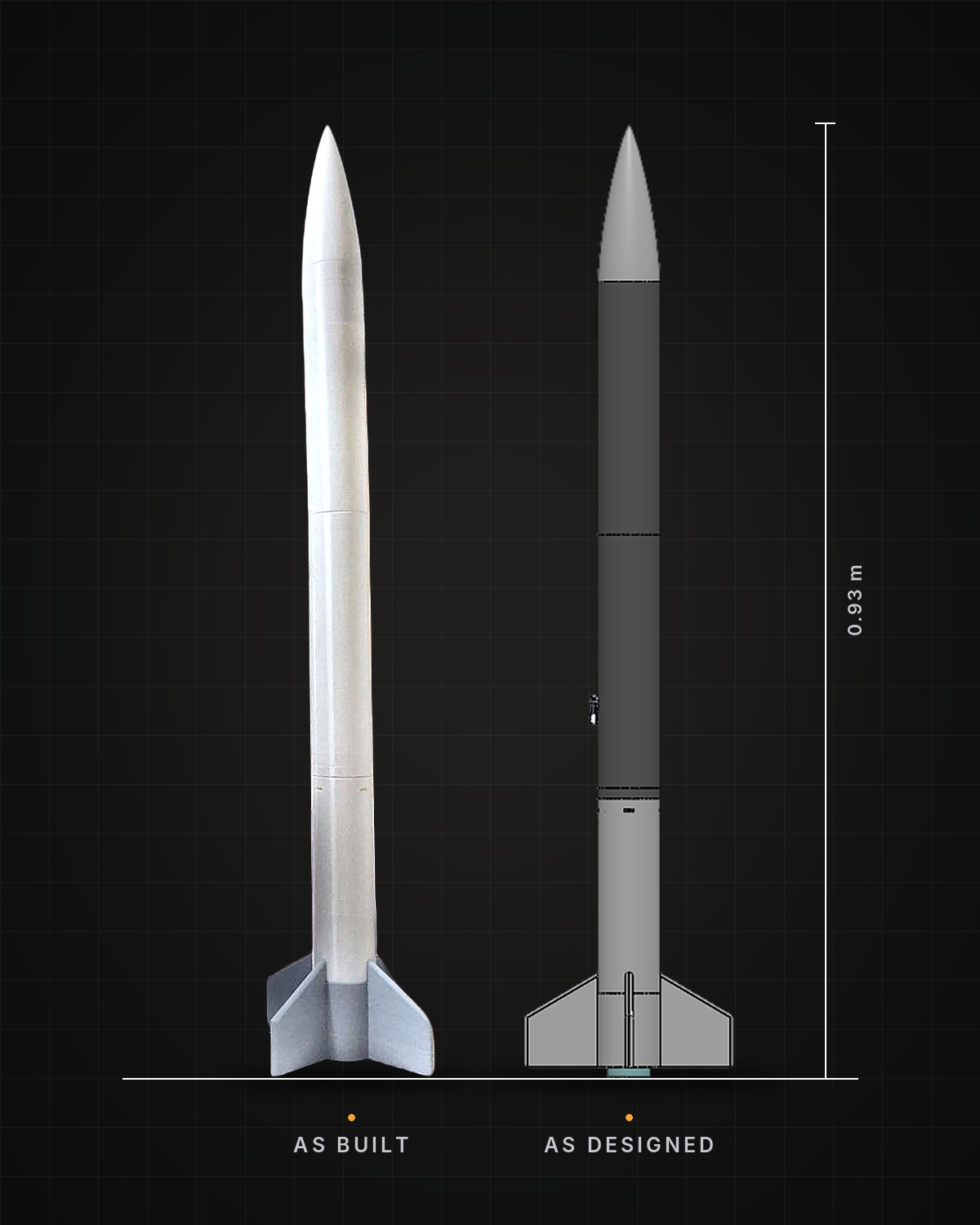
ASCENT-1 is the first rocket KFUPM ASCENT designed, built and flew. It stands 0.93 m tall, measures 60 mm across, and almost every part of it came off our 3D printers. We have flown it twice at our test range in Saudi Arabia, both times on sugar motors we make ourselves, to learn recovery, avionics and launch procedures before building anything bigger.
At a glance
ASCENT-1 is a single-stage, single-parachute rocket on a motor we make ourselves.
| Item | ASCENT-1 |
|---|---|
| Length | 0.93 m |
| Diameter | 60 mm |
| Mass without motor | 1.08 kg |
| Nose cone | Von Kármán (LD-Haack), 150 mm long |
| Fins | 4 trapezoidal, 7 mm thick |
| Airframe | 3D-printed ASA and polycarbonate (PC) |
| Motor | I502, our own KNSU sugar motor, 50 mm × 275 mm |
| Recovery | 30 in (0.76 m) parachute, deployed just after apogee |
| Design speed | Below Mach 0.85 |
All figures come from our OpenRocket 24.12 model of ASCENT-1.
Shape and structure
ASCENT-1 is slender: 0.93 m long and 60 mm wide, a length-to-diameter ratio of 15.5. Its nose cone follows the Von Kármán profile, a low-drag shape that suits a rocket built to fly fast but stay subsonic.
At the tail, a printed fin can carries four trapezoidal fins: 90 mm at the root, 49 mm at the tip and 68 mm in span, with the leading edge swept back about 30°. Each fin has rounded edges and a 5 mm fillet where it meets the tube.
The nose cone, fins, fin can, motor section and bulkheads are printed in ASA, a tough, UV-stable filament that copes with the Saudi sun. The recovery bay and coupler are printed in polycarbonate (PC).
Inside the airframe
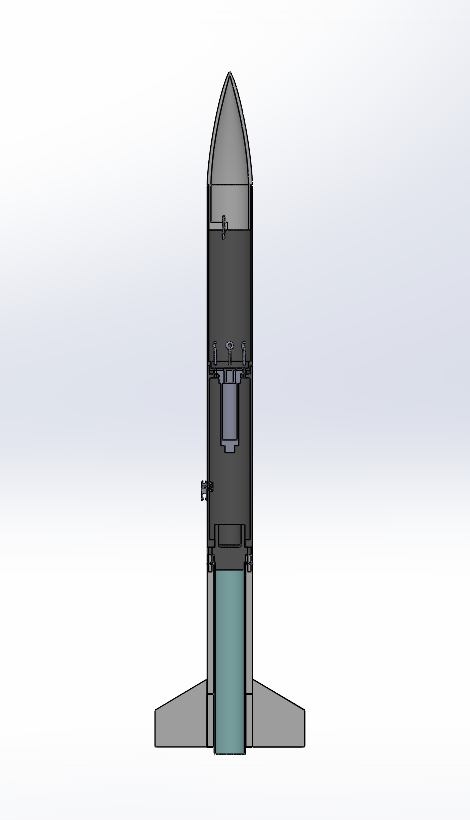
From nose to tail, ASCENT-1 stacks a nose cone, a recovery bay, an avionics bay, a short coupler band, the motor section and the fin can.
| Section | Length | What's inside |
|---|---|---|
| Nose cone | 150 mm | Hollow 2 mm shell, with a 60 mm shoulder that slides into the recovery bay |
| Recovery bay | 240 mm | Fruity Chutes Compact Elliptical parachute and 2 m of tubular-nylon shock cord |
| Avionics bay | 240 mm | Flight electronics and the ballast, between two 5 mm bulkheads |
| Coupler band | 10 mm | Joins the avionics bay to the motor section over a 60 mm coupler |
| Motor section | 220 mm | The motor itself: a 4.8 mm wall leaves a 50.4 mm bore, so the airframe doubles as the motor mount |
| Fin can | 70 mm | Four fins; the motor's tail sits 10 mm past the end of the airframe |
One second after apogee, the parachute deploys from the recovery bay.
Propulsion: a sugar motor of our own
ASCENT-1 flies on motors we make ourselves. In our OpenRocket model it carries I502: 50 mm wide, 275 mm long, and burning KNSU, the potassium nitrate and sucrose "rocket candy" of amateur rocketry. The letter I puts its total impulse between 320 and 640 N·s; 502 is its average thrust in newtons.
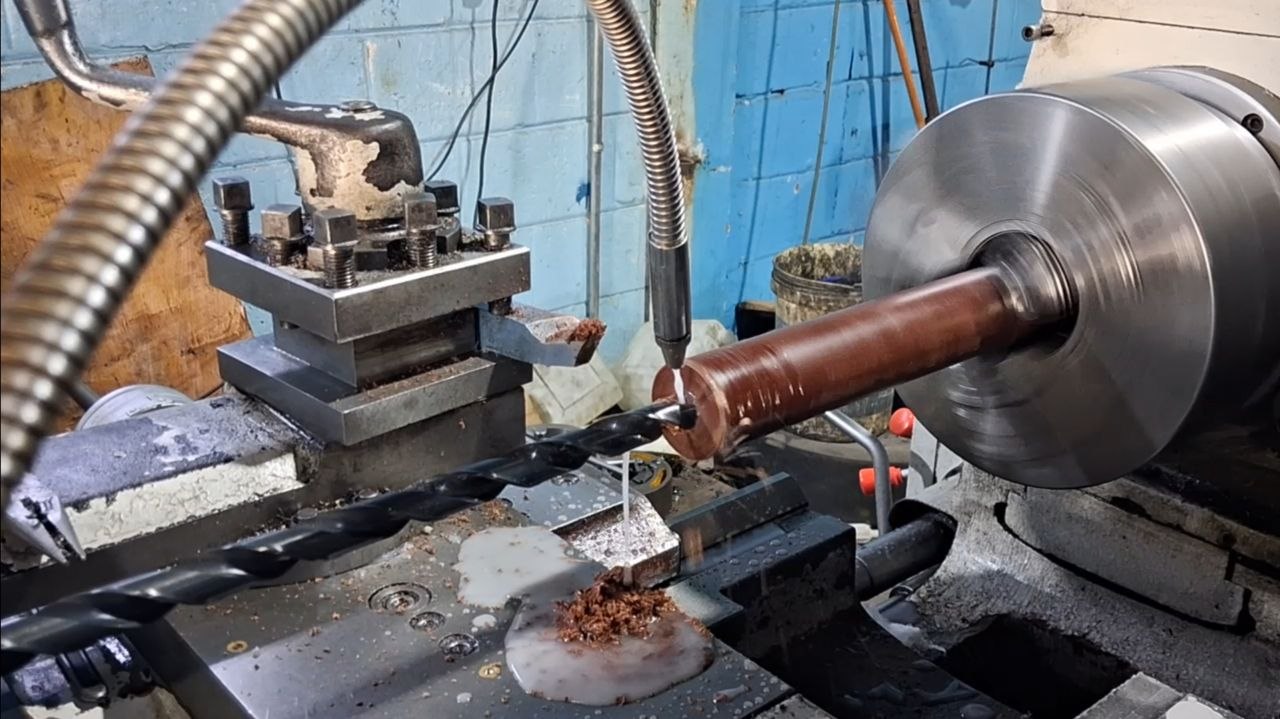
Our latest motor work is the nozzle. A De Laval nozzle squeezes the exhaust through a narrow throat, where the flow reaches the speed of sound. A flared exit cone then lets it expand and speed up.
We sized ours in openMotor, the open-source motor simulator, around our 39 mm × 200 mm KNSU grain with a 16 mm core. The answer is a conical nozzle with a 28 mm exit and a 10.1–11.3 mm throat; the casing's pressure rating picks the final throat. The flared exit alone adds 27–31% impulse over a nozzle that only converges.
Across that throat window, openMotor predicts 441–458 N·s of total impulse and 469–540 N of average thrust, the range our I502 sits in. These are still paper numbers built on textbook KNSU data; firing the motor on a load cell turns them into measured ones.
Where the weight goes
Ballast is the heaviest single item on ASCENT-1: 443 g, as much as the entire airframe structure.
Ballast weighs as much as the entire airframe structure
443 g of ballast is 41% of the 1,077 g ASCENT-1 weighs without its motor
Airframe structure: nose cone, three body tubes, coupler band, two bulkheads, and the fin can with its fins. Avionics is an allowance in the model, not a weighed mass.
ASCENT_1.ork · OpenRocket 24.12 component masses, without motor
Why carry that much dead weight? The I502 is a lot of motor for a rocket this light. Without the ballast it would push ASCENT-1 past Mach 0.85, toward the transonic region where drag rises sharply and loads on printed fins climb.
The ballast holds peak speed below that line. Because it sits ahead of the centre of gravity, it adds stability margin too.
Ground tests and flights
We test on the ground before we test in the air.
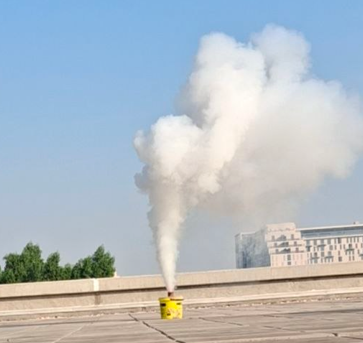
Both of ASCENT-1's flights so far were systems flights, not altitude attempts. That is what our sugar motors are for.
What's next: ASCENT-H1
Everything ASCENT-1 taught us is going into ASCENT-H1, our entry to FAR-OUT 2027. It is a 3.64 m, 114 mm fibreglass rocket on a commercial Contrail M2800-BG hybrid motor. It flies to a contract altitude of 7,000 ft at the Friends of Amateur Rocketry site in the Mojave Desert, 26 May – 1 June 2027.
The habits carry straight over: model every part in OpenRocket and CAD, keep the flight subsonic and predictable, and use ballast to tune it. We will post every ASCENT-H1 test here, numbers included. To support the team or join it, write to kfupmascent@proton.me.
Want to follow ASCENT-H1 on its way to FAR-OUT 2027? Join the team or support the mission.