
KFUPM ASCENT · Student Rocketry Team
ASCENT-H1From Dhahran to the Mojave.
A 7,000 ft hybrid sounding rocket designed, built and tested by KFUPM students. It flies a Contrail M2800-BG nitrous-oxide hybrid in Category A at the Friends of Amateur Rocketry site in the Mojave Desert, California.
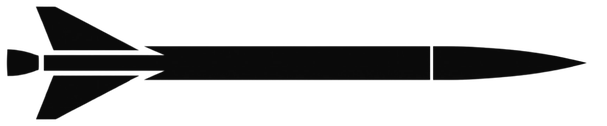
Specified geometry. Illustrative finish and joint positions.
FAR-OUT 2027 launch window · Mojave Desert, California
to the first launch day
01Track record
Built on results
ASCENT-1 built for the 2025–2026 Space Grant Midwest High-Power Rocket Competition
Flights of ASCENT-1 on team-built candy motors in Saudi Arabia
TEKNOFEST 2026 Rocket Competition, A4 international category (rocket Falcon-1)
02The vehicle
ASCENT-H1 in flight
Flight conditions
Trim shot tunes apogee without changing the 500-point payload score.
11 °C is the standard atmosphere at the 620 m FAR site. May temperatures at FAR average 22–34 °C.
FAR-OUT does not launch in winds over 20 mph. In this model the ascent stays vertical and wind moves the landing point.
- Apogee
- 7,000 ft
- Max velocity
- 217 m/s
- Peak acceleration
- 21.6 g
- Rail exit (4.88 m guided)
- 30.5 m/s
- Liftoff thrust-to-weight
- 9.70 : 1
- Main descent
- 15.4 ft/s
- Flight time
- 3:29
- Landing drift
- 421 m
2,134 m · Δ +0 ft vs 7,000 ft contract
Mach 0.64 · 710 ft/s
100.1 ft/s
Meets 100 ft/s design ruleCertified-summary average / liftoff weight
Meets 8 : 1 minimum4.70 m/s
Within 25 ft/s payload limit209.4 s
Downwind from the pad
- Altitude
- 0 ft
- Velocity
- 0.0 ft/s
- Acceleration
- 0.0 g
- Mach
- 0.00
Simulated with a one-dimensional point-mass model: the supplied Contrail M2800-BG thrust samples from a user-submitted ThrustCurve file, 4.4 kg of propellant burned in proportion to impulse, the standard atmosphere from the 620 m FAR site adjusted for pad temperature, and a constant drag coefficient of 0.569 calibrated so the baseline reaches the 7,000 ft contract. Baseline rail-exit speed and payload-trim sensitivity match the supplied reference values. The ascent is vertical and wind only moves the landing point. Scene at true scale; terrain and lighting are illustrative. This is a calibrated model, not measured flight data or an independent OpenRocket validation. Checks use the supplied project thresholds, not a complete launch-safety assessment.
OpenRocket · revision C
Rocket components
Dimensions are from the supplied OpenRocket rev C file. Its airframe is 3.6415 m long; the motor extends beyond the tail. The rounded programme specification remains 3.7 m / 114 mm.
SECTION 01 · 571.5 mm · 0.00 cm from nose
Nose cone & forward tracker
571.5 mm fiberglass 5:1 von Kármán nose with an aluminium tip. A forward Featherweight GPS tracker has its own battery and switch. Six radial screws pin the shoulder to the payload bay; the nose is removable on the ground, not a recovery separation point.
OpenRocket screenshot results
- Loaded mass
- 27.026 kg
- Without motor
- 16.326 kg
- Apogee
- 2,152 m
- Max. velocity
- 217 m/s
- Max. Mach
- 0.643
- Max. acceleration
- 212 m/s²
Results transcribed from your OpenRocket screenshot, not measured flight data. The uploaded file has simulation setups but no saved time-series results. The flight workspace separately calculates a calibrated 1-DOF model; the contract apogee is 2,134 m.
The default configuration requires Contrail_M2800-BG_KFUPM.rse, a custom curve modelling 4.4 kg of propellant and the oxidizer draining from the forward tank. That motor file is not included in this upload.
- Length
- 3.7 m
- Diameter
- 114 mm (4.5 in)
- Liftoff mass
- 27.0 kg
- Contract apogee
- 2,134 m (7,000 ft)
- Thrust-to-weight
- 9.7 : 1
- Rail exit
- 30.6 m/s (100 ft/s)
- Payload
- 5.5 kg / 5.5 L
- Main descent
- ≈ 16 ft/s
03Test campaign
Proven before the Mojave
before 15 Apr 2027
Ground tests
Ejection and shear-pin tests on both separation joints, Blue Raven and Blue Jay bench and arming tests, fill-system wet dress rehearsal, recovery testing. All of it is documented in the FAR-OUT Final Progress Update.
Saudi Arabia
Systems flight
A full-vehicle flight before the hardware freeze to exercise both altimeters, both GPS trackers and the complete recovery chain.
04Engineering blog
From the workshop
Competition
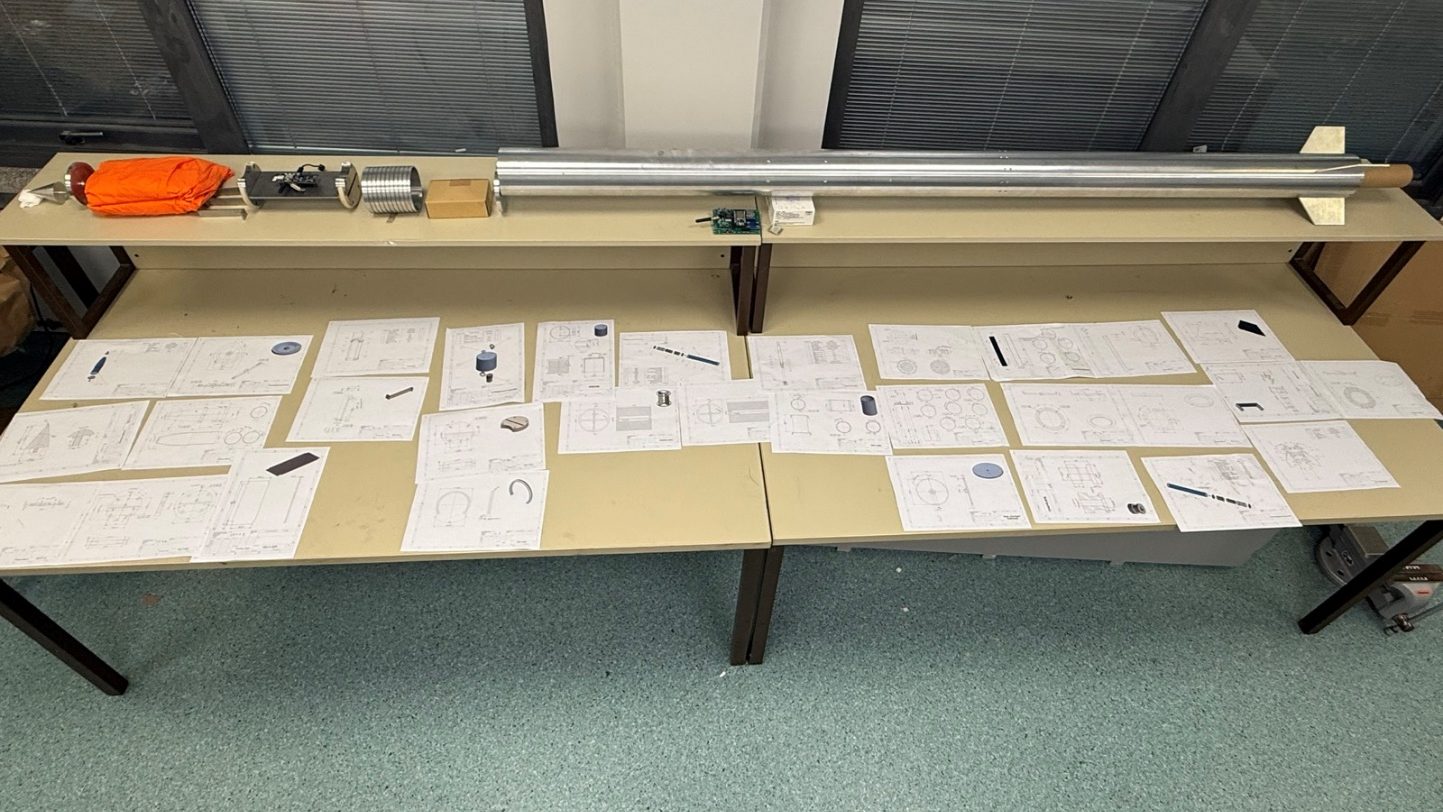
Falcon-1 at TEKNOFEST 2026: building the rocket that took 2nd in A4 International
1 Nov 2026
Propulsion
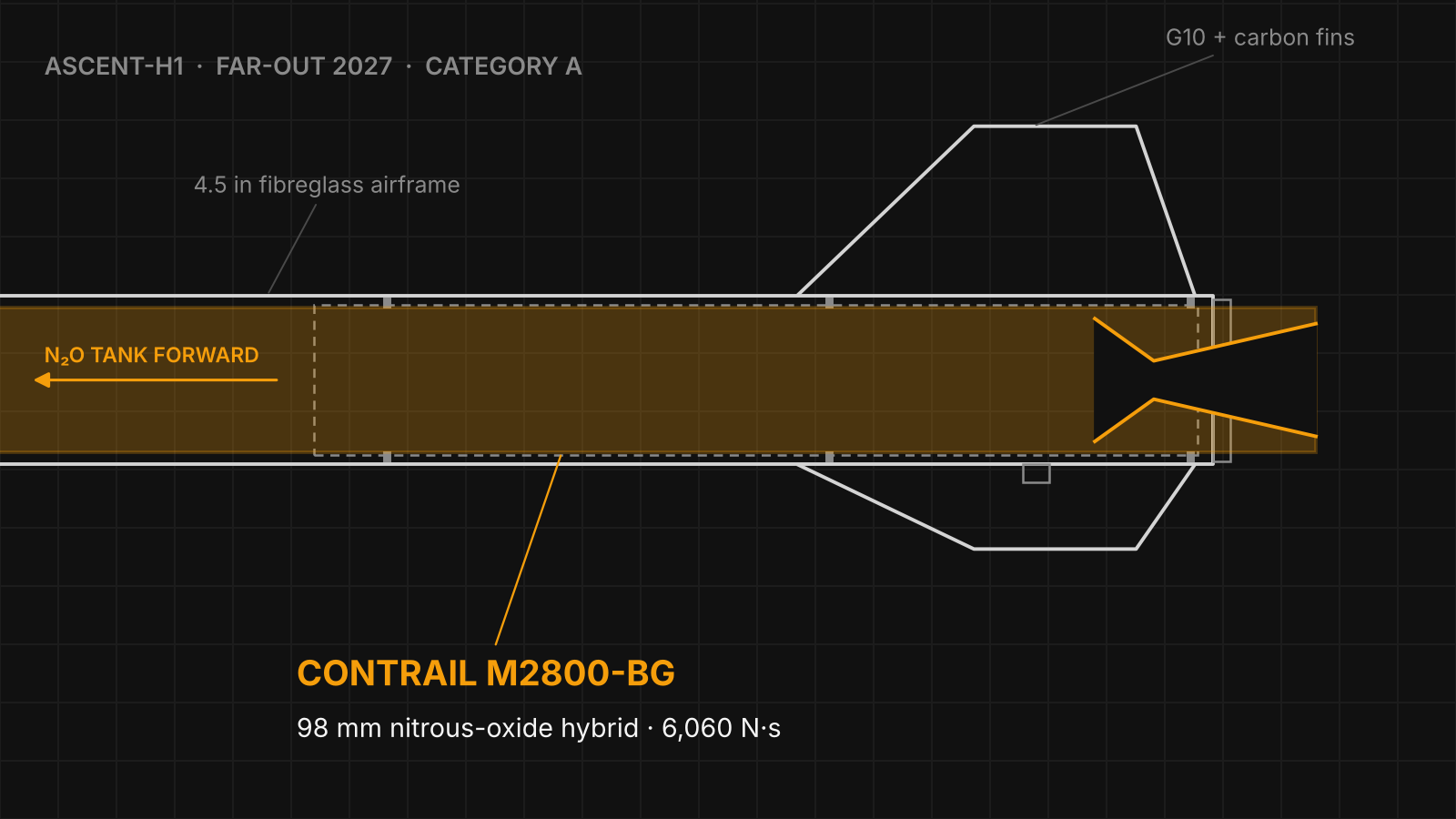
Why we chose a COTS hybrid for our first FAR-OUT
1 Nov 2026
Aerostructures
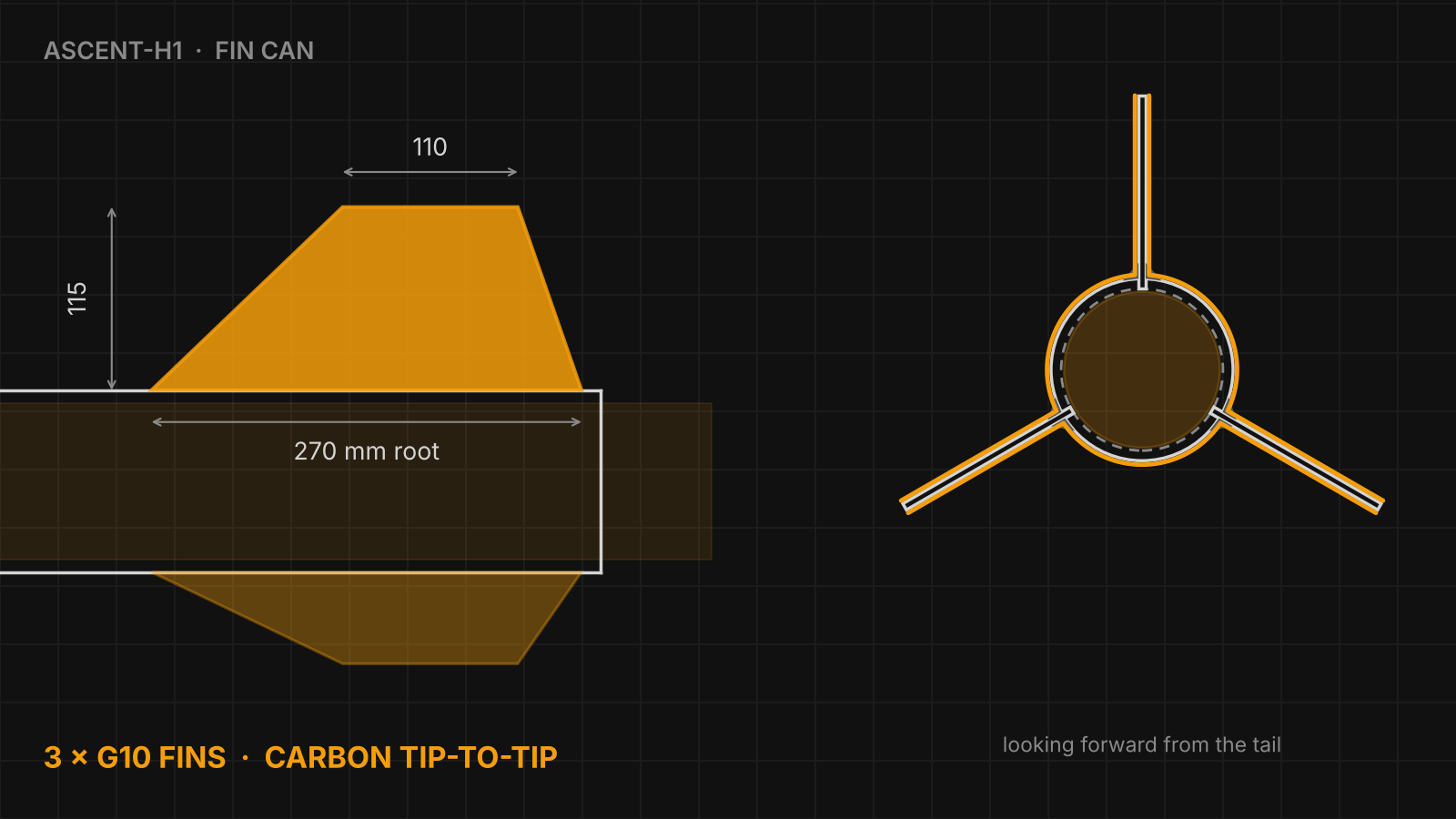
Sizing ASCENT-H1's fins: stability, flutter and the tip-to-tip layup
15 Oct 2026
Team members
Engineering sub-teams
Rockets flown
Competition season
Proudly supported by