
Propulsion · 1 Nov 2026 · KFUPM ASCENT
Why we chose a COTS hybrid for our first FAR-OUT
FAR-OUT is the Friends of Amateur Rocketry's student competition for hybrid and liquid rockets, flown at the FAR site in California's Mojave Desert. The 2027 event runs from 26 May to 1 June. Every team declares a contract apogee months in advance and is scored on how close it gets.
For our first FAR-OUT we are entering Category A with a 7,000 ft contract apogee, flying ASCENT-H1 on a certified commercial (COTS) hybrid: the Contrail Rockets M2800-BG. This post explains how we got there.
Why a hybrid
FAR-OUT only flies hybrid and liquid motors, so a solid was never an option. A hybrid stores its two halves separately: liquid nitrous oxide in a tank, and a solid fuel grain in the combustion chamber. Neither burns on its own, and the nitrous is loaded at the pad shortly before launch.
Why COTS for year one
The FAR-OUT rules accept COTS hybrids, research hybrids and research liquid engines, and COTS is not required. A student-built motor comes with its own work, though: research pressure vessels must be proof-tested to 1.5 times their maximum operating pressure, disposable parts must be tested at least twice, and Category A and B motors must show at least 100 s of specific impulse on a test stand.
A certified COTS hybrid does not need that test-performance documentation (FAR still strongly encourages a test flight or firing). In our first year, that means our hours go into the vehicle, ground operations and recovery. Building our own hybrid is a goal for later years.
Why Category A
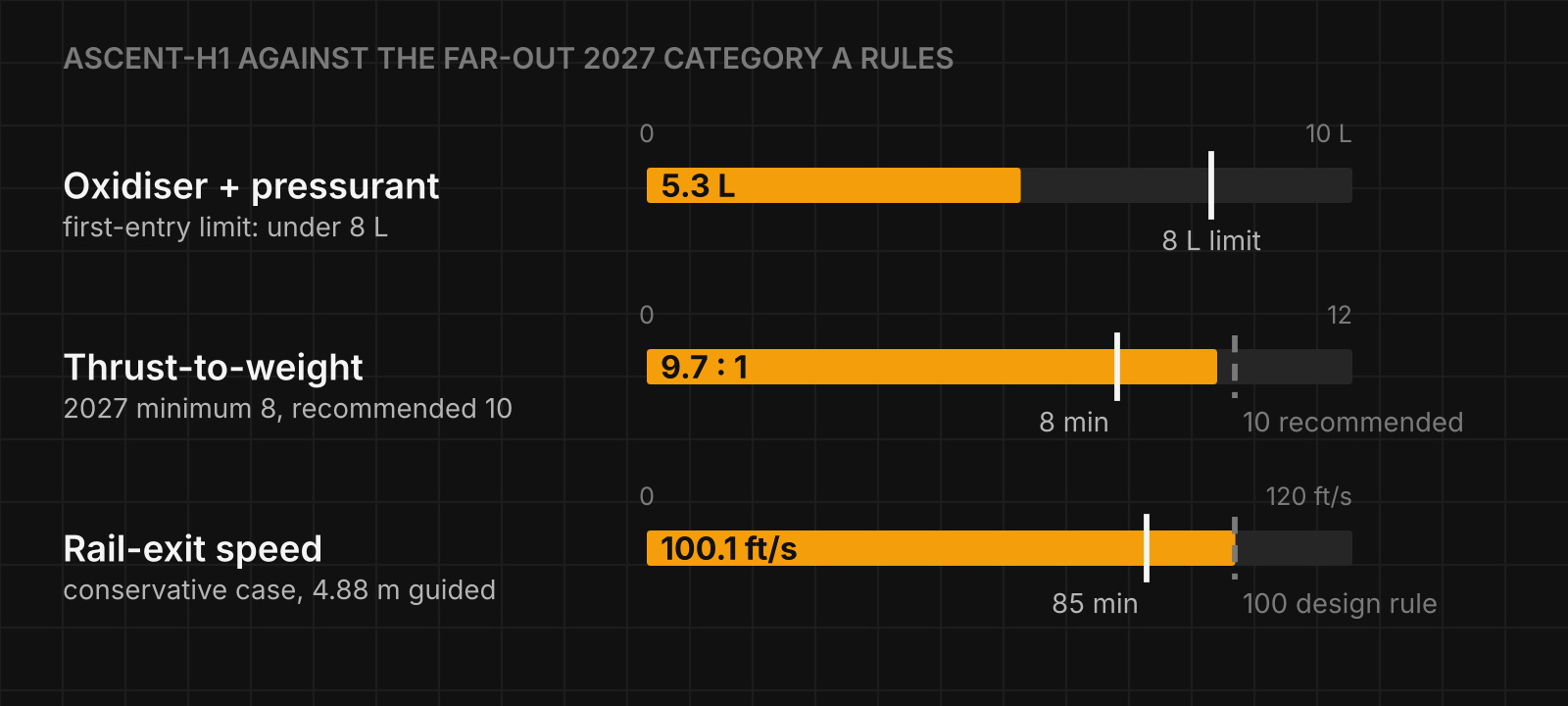
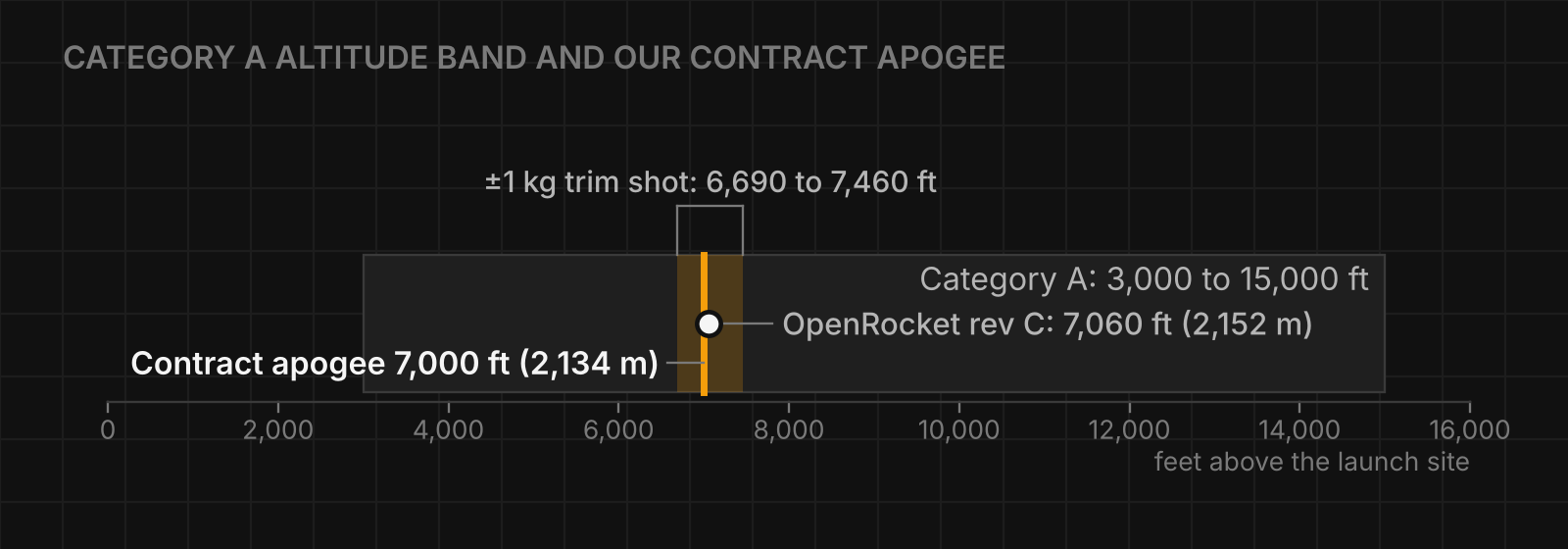
Category A covers apogees from 3,000 to 15,000 ft. Categories B (20,000 to 50,000 ft) and C (50,000 to 250,000 ft) go much higher. Each category also caps how much propellant a first-time entry can carry. In Category A, the total pressurant and liquid propellant volume must be under 8 L. The M2800-BG's nitrous tank holds 5.3 L.
Why the M2800-BG
| Motor | Contrail Rockets M2800-BG, TRA certified |
|---|---|
| Type | Nitrous-oxide hybrid |
| Size | 98 mm × 1,524 mm |
| Oxidiser tank | 5.3 L |
| Total impulse | 6,060 N·s |
| Average thrust | 2,570 N |
| Burn time | 2.3 s |
The M2800-BG ticks three boxes at once:
- It fits the airframe. A 98 mm motor sits neatly in a 4.5 in (114 mm) airframe, the same diameter class as Falcon-1, the TEKNOFEST 2026 rocket several of us worked on.
- It is under the first-entry limit. 5.3 L of nitrous against an 8 L cap.
- It has thrust to spare. At ASCENT-H1's 27.0 kg lift-off mass, its average thrust gives a thrust-to-weight of 9.7:1, above the 2027 minimum of 8:1. FAR recommends 10:1 and raises the minimum above 10 from 2028, so we watch every gram that goes into the rocket.
ASCENT-H1 also leaves the rail at 100.1 ft/s in our conservative case, which counts only the 4.88 m of a 20 ft rail where the rocket is still guided. The rules require more than 85 ft/s and ask teams to design for 100 ft/s.
Building the rocket around the motor
ASCENT-H1's airframe is 4.5 in Wildman G12 filament-wound fibreglass, 3.64 m long, with a 5:1 von Kármán nose cone and an aluminium tip. The motor sticks out 70 mm past the tail, so the rocket is 3.71 m overall.
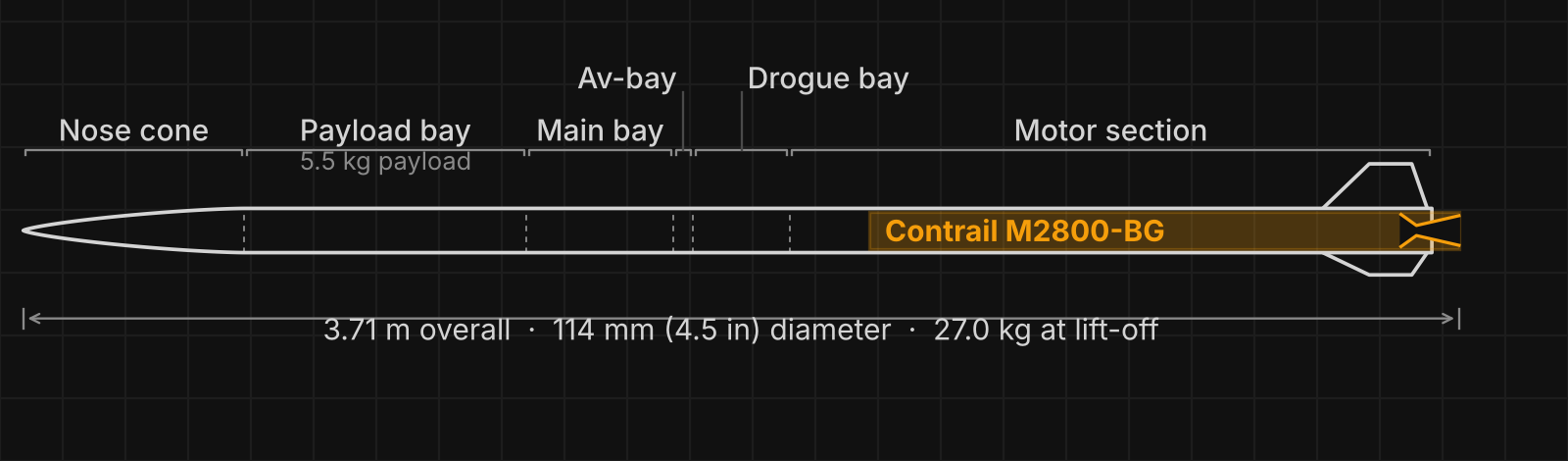
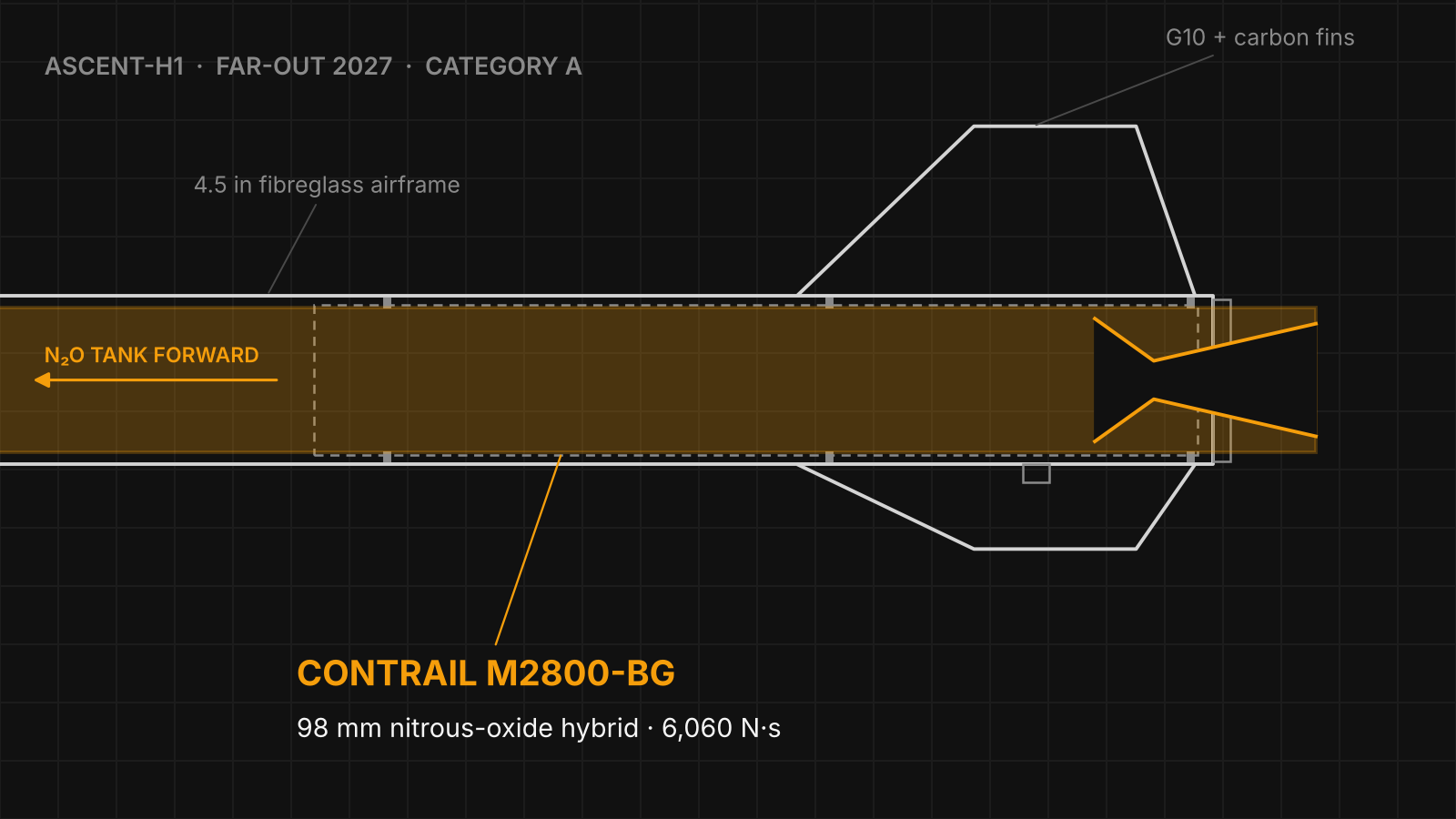
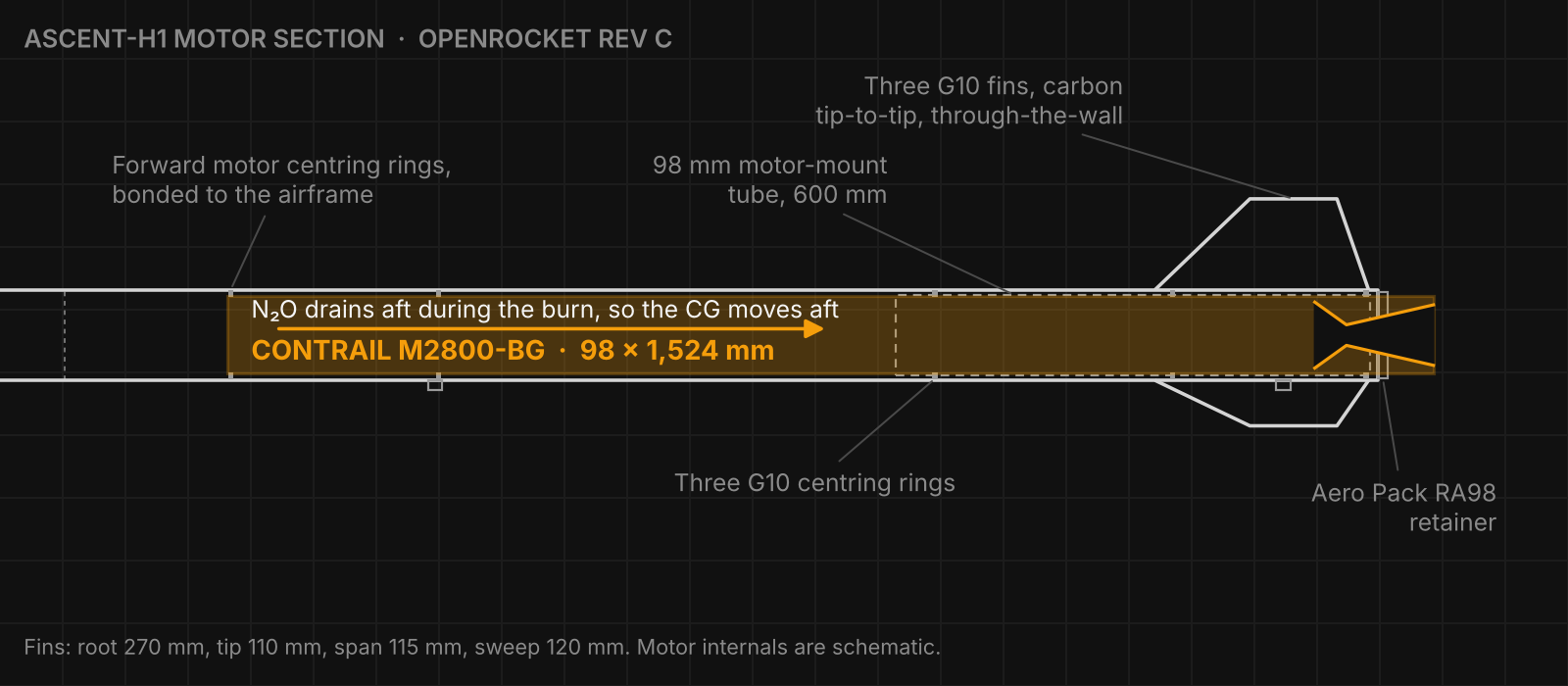
The motor is 1,524 mm long and runs most of the length of the motor section, so it is held at both ends:
- At the aft end, a 600 mm, 98 mm motor-mount tube sits in the fin can on three G10 centring rings, with an Aero Pack RA98 retainer.
- At the forward end, two G10 centring rings bonded to the airframe locate the front of the motor.
- The fins are three G10 plates with a carbon tip-to-tip layup, mounted through the wall.
- The rail buttons are 1.07 m apart. The forward one screws into a G10 backing ring bonded to the airframe 2.45 m from the nose, and the aft one sits 120 mm from the tail.
Modelling a hybrid honestly
A hybrid is harder to simulate than a solid, and we found that out quickly. OpenRocket's built-in M2800-BG entry lists only 0.476 kg of propellant, so a simulation using it under-predicts apogee.
Our rev C model uses a custom thrust-curve file with the corrected 4.4 kg of propellant. It also models the nitrous draining out of the forward tank, so the motor's centre of gravity moves aft as it burns. That matters twice:
- Apogee: how much mass the rocket loses during the burn decides how high it coasts.
- Stability: as the centre of gravity moves aft, the stability margin shrinks while the motor is still burning. We sized the fins to keep at least 1.5 calibres of stability at rail exit in a 10 mph crosswind.
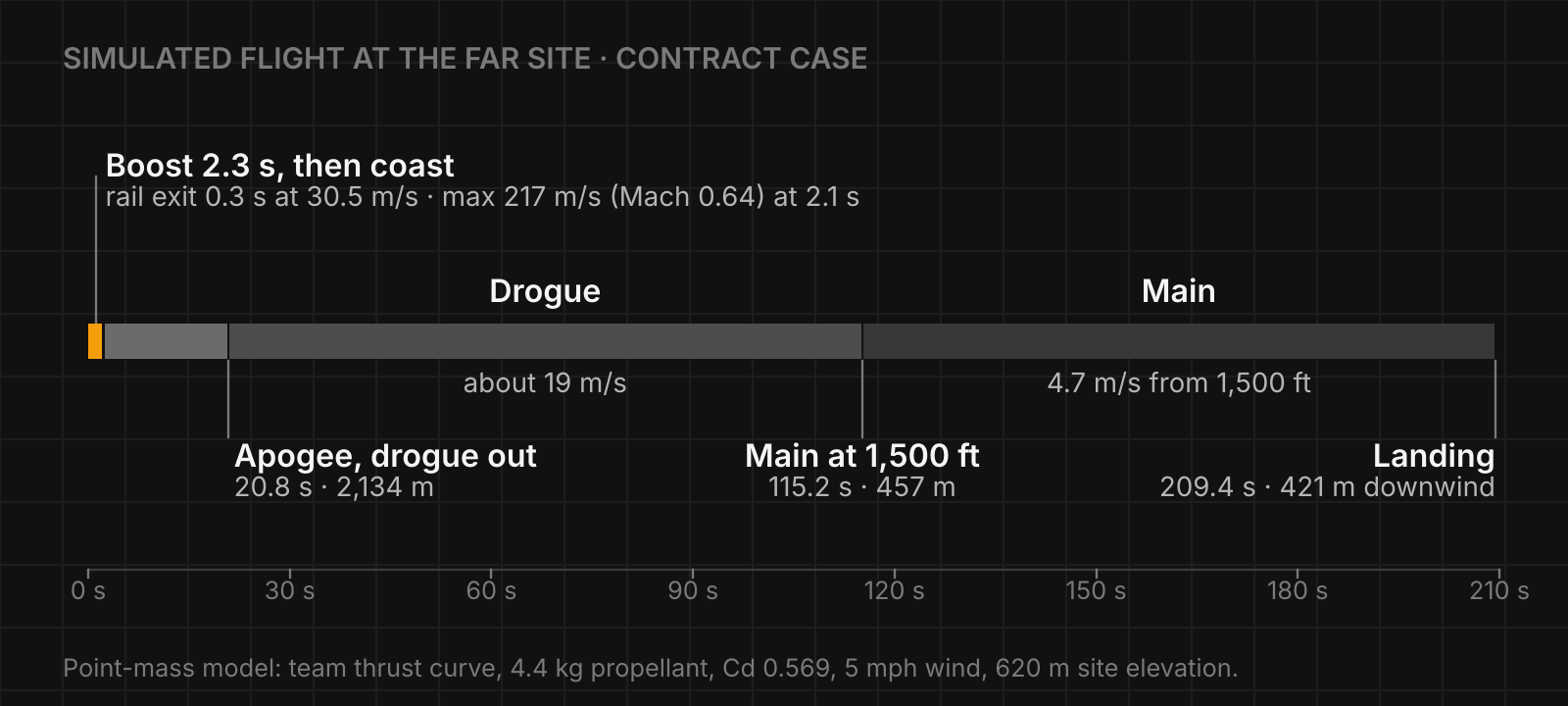
With the corrected motor, OpenRocket predicts an apogee of 2,152 m (7,060 ft). Our point-mass model on the same thrust curve predicts 2,134 m (7,000 ft). ASCENT-H1 peaks at 217 m/s (Mach 0.64) and 21.6 g, burns out at 2.3 s and reaches apogee at about 21 s.
Accuracy is the game
FAR-OUT scores altitude accuracy against the contract apogee, how well the simulation matches the day's weather, the payload, a hybrid/liquid motor performance bonus, recovery, launch bonuses, the poster, technical report and checklists, and sportsmanship and outreach.
That is why the motor choice is only half the story. ASCENT-H1 carries a 5.5 kg, 5.5 L payload canister, plus 1 kg of removable trim shot either way. Moving that 1 kg in or out shifts the predicted apogee between about 6,690 and 7,460 ft without touching the payload score. On launch day, with the forecast in hand, we can trim the rocket to the contract.
What's next
- 15 January 2027: our Initial Progress Update, where we formally declare the 7,000 ft contract apogee.
- Before 15 April 2027: a systems flight in Saudi Arabia, ahead of the hardware freeze at the Final Progress Update.
- 29 May to 1 June 2027: launch days at the FAR site from 29 to 31 May, then Category A morning launches and the awards on 1 June.
Follow the build on the ASCENT-H1 page, read how Falcon-1 took second at TEKNOFEST 2026, or support the mission.